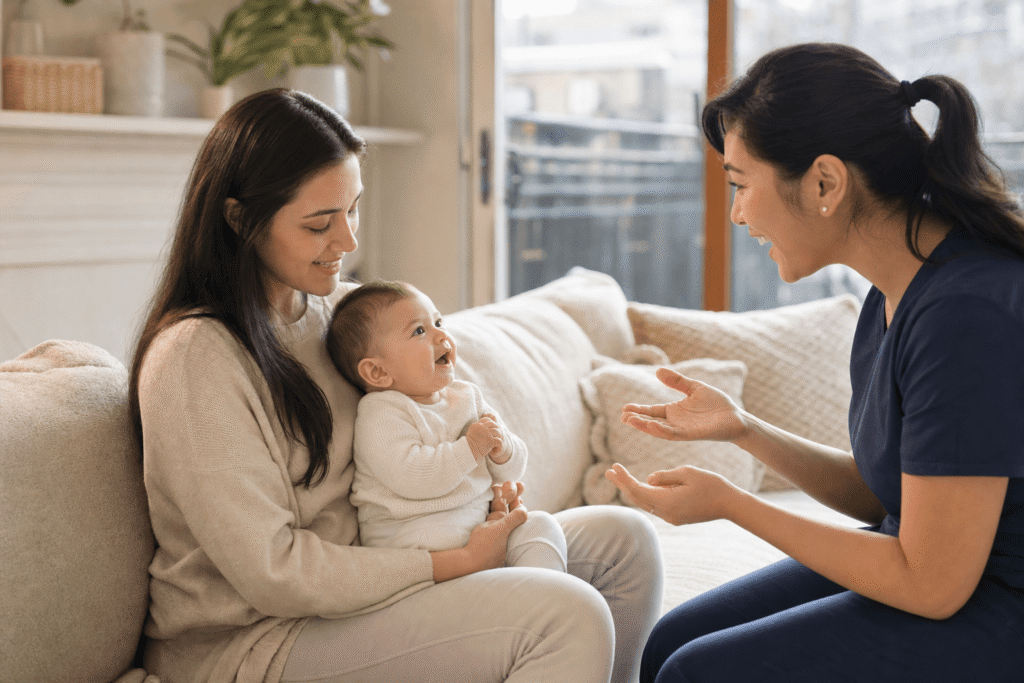
When do infants start speaking? Most babies say their first recognizable words between 10 and 14 months, though the journey from newborn cries to meaningful conversation begins at birth. Understanding infant speech development helps you recognize what’s typical, celebrate each milestone, and identify when professional support might help.
This article walks you through the complete timeline of baby speech development milestones, from early coos to full sentences. You’ll learn what to expect at each age, how to encourage language growth, and when speech delays warrant professional evaluation.
Every baby develops at their own pace, and that’s especially true for language. But knowing the general patterns gives you confidence as a parent.
Quick Answer
Most infants say their first intentional words between 10 and 14 months old. Before that, babies communicate through crying, cooing (around 2-3 months), and babbling (starting around 6 months), building the foundation for speech that continues developing through age three and beyond.
Understanding Infant Speech Development: From First Sounds to First Words
Language development starts the day your baby is born. Those first cries are communication, not just noise. Your newborn is already listening to your voice, recognizing familiar sounds, and preparing the neural pathways needed for speech.
The process unfolds in predictable stages, though individual timing varies widely. Receptive language (understanding words) develops before expressive language (saying words). Your baby comprehends far more than they can say, sometimes by months.
During those exhausting early weeks, every conversation you have with your infant matters. When you narrate diaper changes or respond to coos, you’re teaching language patterns. Your baby learns that sounds have meaning, that communication goes back and forth, and that their voice gets responses.
The Vancouver families our team supports often worry they’re not doing enough to encourage speech. But you don’t need flashcards or special programs. Consistent, warm interaction during daily routines builds language skills more effectively than any app.
Key Takeaways
- Expect first words between 10-14 months, but babbling starts much earlier
- Track both receptive and expressive language to understand full development
- Recognize that bilingual exposure doesn’t delay speech when measured properly
- Seek evaluation if your 18-month-old uses fewer than 10 words
- Support language growth through everyday conversation, not special programs
Age-by-Age Speech Milestones: Birth to 3 Years
Understanding what happens at each stage helps you celebrate progress and recognize potential concerns early. These timelines represent typical development, not rigid requirements.
Birth to 6 Months: Cooing, Crying, and Early Babbling
Your newborn arrives with only crying as a communication tool. But within weeks, the repertoire expands. By 2-3 months, most babies start cooing, those sweet vowel sounds that make your heart melt.
Around 4 months, you might hear your baby experimenting with consonant sounds. Those early “guh” and “buh” sounds don’t mean anything yet, but they’re crucial practice. Your baby is learning how to coordinate breath, vocal cords, tongue, and lips.
By 6 months, true babbling typically emerges. Your baby strings together consonant-vowel combinations: “bababa” or “dadada.” This isn’t speech yet, it’s vocal play. But it sounds so close to real words that parents get excited.
During home visits across Vancouver, our newborn care specialists often reassure parents that quiet babies aren’t necessarily behind. Some infants are naturally more vocal than others. What matters more is whether your baby responds to your voice and makes eye contact during interaction.
7 to 18 Months: Babbling Variety and First Intentional Words
Between 7 and 12 months, babbling becomes more complex. Your baby experiments with different tones, pitches, and rhythms. It starts sounding like conversation, complete with pauses for your response.
Around 9 months, many babies understand simple words like “no” and “bye-bye,” even if they can’t say them yet. This receptive language milestone is just as important as first words.
First intentional words typically appear between 10 and 14 months. “Mama,” “dada,” “ball,” and “dog” are common early choices. The key is intentionality: your baby uses the same sound consistently to mean the same thing.
By 18 months, most toddlers use 10-20 words and understand many more. Some say 50 or more words at this age, while others use just a handful. This wide variation is normal, though fewer than 10 words at 18 months warrants professional evaluation.
Parents sometimes ask whether late walkers talk later. There’s often a connection between physical milestones and speech timing. Babies focused on mastering movement sometimes put language on the back burner temporarily. You can read more about how crawling timing relates to overall development patterns.
During postpartum visits, we often notice that babies whose parents narrate daily activities, even simple routines like washing hands or sorting laundry, show stronger engagement and vocalization. You don’t need special activities; just describe what you’re doing together.
18 Months to 3 Years: Vocabulary Explosion and Sentence Formation
Around 18-24 months, many toddlers experience a vocabulary explosion. Word learning accelerates dramatically. A child who knew 20 words at 18 months might know 200 by age two.
Two-word phrases typically emerge between 18 and 24 months. “More milk,” “daddy go,” “big truck.” These simple combinations represent a huge cognitive leap. Your toddler is beginning to use grammar.
By age two, most children use 50-100 words and combine them into short sentences. By age three, vocabulary reaches 500-1000 words, and your child speaks in longer sentences that strangers can mostly understand.
Pronunciation improves gradually. Don’t expect perfect articulation at age two. Many consonant sounds like “r,” “l,” and “th” develop later, sometimes not until age five or six.
| Age | Typical Speech Milestone | Vocabulary Range |
|---|---|---|
| Birth-3 months | Crying, startles at sounds, begins cooing | 0 words (pre-linguistic) |
| 4-6 months | Babbling begins, responds to name | 0 words (pre-linguistic) |
| 7-12 months | Varied babbling, first intentional words | 1-5 words |
| 12-18 months | Single words, follows simple commands | 10-20 words |
| 18-24 months | Two-word phrases, vocabulary explosion begins | 50-100 words |
| 2-3 years | Short sentences, asks questions, 75% intelligible | 200-1000 words |
How Many Words Should My Child Say at Each Age?
This question keeps parents awake at night. You compare your child to cousins, daycare friends, or developmental charts, and worry creeps in.
Here’s what research tells us about typical vocabulary size. Remember, these are averages. Plenty of healthy children fall outside these ranges.
At 12 months, the average is about 2-6 words, though some babies say none and others say 15. At 18 months, typical vocabulary ranges from 10-50 words, with significant individual variation. By 24 months, most toddlers use 50-200 words, and by age three, vocabulary ranges from 500-1000 words.
What matters more than hitting exact numbers? Steady progress. A child who goes from 5 words at 18 months to 30 words at 20 months is developing well, even if they’re below average. A child stuck at the same 5 words for months needs evaluation.
Also consider receptive language. A 20-month-old who says only 8 words but clearly understands 50+ words and follows two-step directions is showing healthy language development. Understanding always runs ahead of speaking.
Need support with your newborn?
Our team of registered nurses, doulas, and lactation consultants offer in-home visits across Vancouver and virtual sessions from anywhere in BC.
What Factors Influence When Infants Start Speaking?
Why does one baby talk at 10 months while another waits until 16 months? Multiple factors shape speech development timing, and most are completely beyond your control.
Genetics play a significant role. If you or your partner talked late, your baby has higher odds of following that pattern. Family history of speech delays increases risk, though it doesn’t guarantee your child will have delays.
Hearing is fundamental to speech development. Even mild or temporary hearing loss from chronic ear infections can delay language. That’s why pediatricians take ear infections seriously in the first two years.
Gender shows up in the data. Girls, on average, talk earlier than boys and develop larger vocabularies faster. But this is a statistical trend, not a rule. Plenty of boys are early talkers.
Birth order matters too. Second and third children sometimes talk later than firstborns, possibly because older siblings do the talking for them. Or they talk earlier because they’re immersed in language from birth. It varies.
Bilingual Households and Speech Development Expectations
One of the most common concerns among Vancouver’s diverse families: will learning two languages delay my baby’s speech?
The short answer is no. Bilingual children don’t have true language delays compared to monolingual peers when you measure their total vocabulary across both languages. A bilingual 18-month-old might know 10 English words and 10 Mandarin words, meeting the 20-word milestone even though they’re split between languages.
Bilingual toddlers sometimes mix languages in the same sentence. This is normal code-switching, not confusion. They’re demonstrating sophisticated language awareness by choosing words from whichever language expresses their meaning best. If your household speaks multiple languages, speak to your child in whichever language feels most natural to you. Your baby benefits most from rich, fluent language input.
How Vancouver’s Natural Environment Supports Early Language Development
Vancouver’s outdoor spaces provide unique opportunities for language development through rich sensory experiences. Nature exposure supports speech skills in ways indoor environments cannot replicate.
Outdoor environments offer endless vocabulary building. At Pacific Spirit Park, the seawall, or local beaches, you encounter diverse sensory input: wind on skin, bird calls, ocean sounds, tree movements, saltwater smells. Each sensation becomes a language opportunity. “Feel the wind? It’s blowing the leaves. I hear a crow calling. The ocean water is splashing.”
This multi-sensory stimulation strengthens neural connections supporting all learning, including language. Your baby’s brain integrates sight, sound, smell, touch, and movement simultaneously, creating stronger memory anchors for new words than indoor settings provide.
Natural settings also reduce parental stress. Lower cortisol levels mean you’re more relaxed and likely to engage in extended conversation. The changing scenery gives you endless things to discuss without planning activities. Even brief walks in rainy weather provide language-rich experiences. “The raindrops are falling. Your coat is getting wet. The umbrella keeps us dry.”
Regular outdoor time with engaged caregivers who narrate experiences creates optimal conditions for language growth through natural, ongoing conversation rather than structured lessons.
How Parental Stress and Mental Health Affect Language Development
The emotional environment shapes language development as profoundly as genetics. Parental stress, postpartum depression, and family dynamics directly impact verbal interaction quantity and quality.
Research shows mothers experiencing postpartum depression often speak less to infants, use fewer varied words, and engage in less back-and-forth conversation. This isn’t failure, it’s biology. Depression makes everything harder, including the constant narration that builds language skills.
High stress from any source reduces emotional bandwidth for rich verbal interaction. When overwhelmed, you focus on physical needs but may miss opportunities for playful, extended conversations that accelerate speech development.
Getting support for your mental health directly benefits your child’s development. When you feel better, you naturally engage more. Our team’s postpartum support services provide companionship that reduces isolation, models warm infant interaction, and gives you breaks to recover emotionally, creating better conditions for your baby’s language growth.
Evidence-Based Ways to Encourage Your Baby to Talk
You can’t force speech development, but you can create an environment that nurtures language growth. These strategies are backed by research and observed in thousands of homes.
Talk to your baby constantly. Narrate what you’re doing: “I’m washing your feet. The water is warm. Now we’re drying your toes.” This running commentary teaches vocabulary, sentence structure, and turn-taking.
Respond to every vocalization. When your 4-month-old coos, coo back. When your 10-month-old says “babababa,” reply with “Yes, you’re talking to mama!” This teaches that communication is interactive.
Read together daily. Even young babies benefit from hearing stories. The rhythm of language, exposure to new words, and cozy connection all support speech development. By age one, point to pictures and name objects.
Limit screen time significantly. Babies under 18 months learn very little language from screens, even educational programs. They need back-and-forth interaction with real humans. Passive listening doesn’t build the neural pathways that conversation does.
Expand your child’s attempts. If your toddler says “dog,” you might respond “Yes, that’s a big brown dog!” You’re validating their word while modeling more complex language.
Create communication opportunities. Instead of automatically giving your baby what they want, pause and wait. If they point at milk, say “Milk? You want milk? Say milk.” Don’t withhold the item if they can’t say it, but create the opportunity to try.
Sing songs and nursery rhymes. The repetition, rhythm, and exaggerated sounds of children’s songs support language processing and memory. Plus, they’re fun.
Families working with our experienced newborn care specialists often report that having consistent, engaged caregivers who talk to babies during daily care accelerates language development through natural, ongoing conversation.
When working with families whose babies have feeding challenges, we often see speech concerns emerge later. Early intervention for tongue tie, poor latch, or oral motor difficulties can prevent language delays down the road, making lactation support an investment in long-term development.
Warning Signs of Speech Delays and When to Seek Help
Most variation in speech timing is completely normal. But certain red flags warrant professional evaluation. Trust your instincts. If something feels off, seeking assessment does no harm.
By 12 months, your baby should respond to their name, make eye contact, and use gestures like waving or pointing. Lack of these pre-linguistic skills is more concerning than absence of words.
By 18 months, most toddlers use at least 10 words and understand simple commands. If your child uses fewer than 10 words or doesn’t seem to understand basic language, contact your pediatrician.
By 24 months, watch for two-word phrases. A two-year-old who speaks only in single words or uses fewer than 50 words needs evaluation. Also concerning: loss of previously acquired words or sounds.
At any age, lack of response to sound, absence of babbling by 9 months, or no words at all by 16 months warrants immediate professional assessment. Early intervention is most effective when started young.
Consider the whole picture. A child with excellent receptive language, strong social engagement, and age-appropriate play skills who happens to talk late is less concerning than a child with multiple developmental delays across domains.
Who should you contact? Start with your pediatrician, who can rule out hearing problems and provide referrals. A speech-language pathologist can conduct comprehensive evaluation and recommend therapy if needed. In BC, some services are covered through public health programs.
Frequently Asked Questions About Infant Speech Development
When do babies typically say their first words?
Most babies say their first recognizable, intentional words between 10 and 14 months old. Some start as early as 8 months, while others don’t speak until 15-16 months. What counts as a “first word” is sound used consistently to mean the same thing, such as “mama” always meaning mother or “buh” always meaning ball. Timing varies widely among healthy babies, and earlier isn’t necessarily better.
How many words should my 18-month-old be saying?
At 18 months, most toddlers use between 10 and 50 words, with significant normal variation. Some say just 8-10 words while others have vocabularies of 80+ words. Both can be typical. What’s more important than hitting a specific number is steady progress over time and strong receptive language (understanding words). If your 18-month-old uses fewer than 10 words and shows limited understanding, discuss this with your pediatrician.
How many words should a 2-year-old say?
By age two, most children use 50-200 words and combine them into simple two-word phrases like “more juice” or “daddy go.” Some two-year-olds speak in longer sentences with 300+ word vocabularies, while others are just beginning to combine words. As long as your child is making steady progress and you can understand at least half of what they say, they’re likely developing normally. Fewer than 50 words or no two-word combinations at 24 months warrants evaluation.
What are the warning signs that my child needs speech therapy?
Red flags include no babbling by 9 months, no words by 16 months, fewer than 10 words at 18 months, no two-word phrases by age two and a half, or loss of previously acquired language skills. Also concerning: not responding to their name by 12 months, lack of gestures like pointing or waving, difficulty being understood by family members by age three, or persistent frustration when trying to communicate. If you notice any of these signs, contact your pediatrician for assessment and possible referral to a speech-language pathologist.
Do bilingual children start talking later than monolingual children?
No, bilingual children do not experience true language delays when you count their total vocabulary across both languages. A bilingual 18-month-old might know 10 words in each language, meeting the 20-word milestone even though it’s split between languages. Some bilingual children speak their first words slightly later as they process more complex linguistic input, but they catch up quickly and often surpass monolingual peers in cognitive flexibility. Continue speaking your native language to your child for the richest language input.
Supporting Your Baby’s Language Journey With Confidence
Speech development unfolds differently for every child, and that’s perfectly normal. Your baby will progress from coos to words to sentences at their own pace, influenced by genetics, temperament, environment, and countless other factors beyond your control.
What you can control is the language-rich environment you create. Every conversation, every story, every song builds your baby’s communication foundation. Trust your instincts. Celebrate each milestone. And seek support when questions arise.
If you’re concerned about your infant’s development or want guidance on supporting early milestones, Newborn Company’s team of registered nurses and specialists provides judgment-free support across Vancouver. Book a consultation online to connect with Bita and our care team, whether you need in-home visits or prefer virtual sessions from anywhere in BC.