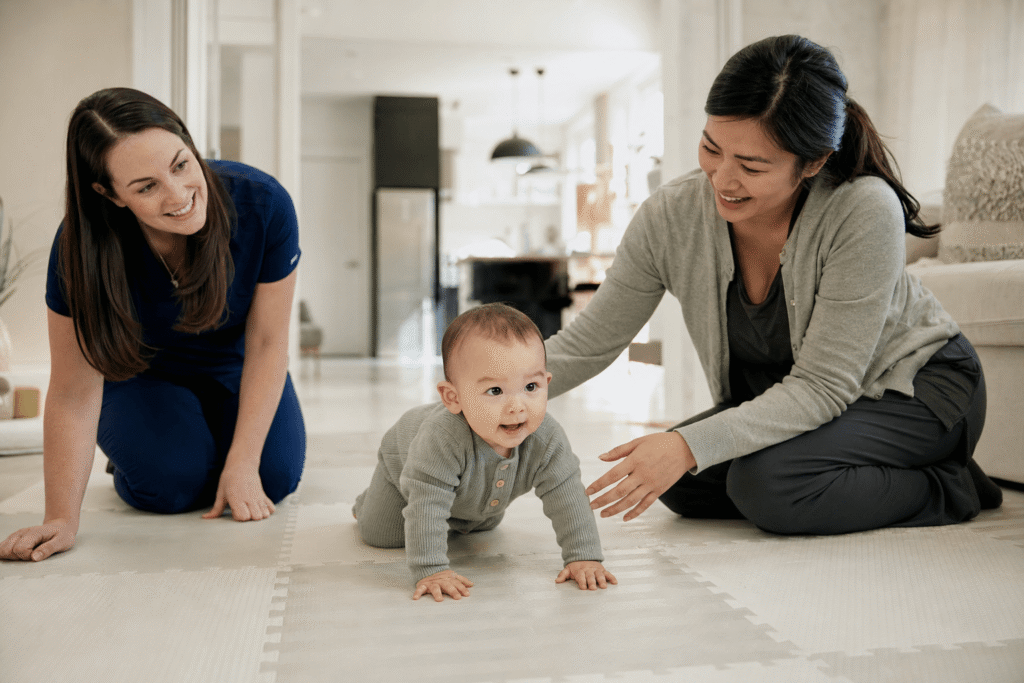
When Do Newborns Crawl? Timeline, Milestones, and Expert Guidance for Parents
Most babies start crawling between 6 and 10 months of age, though some begin as early as 5 months while others don’t crawl until closer to their first birthday. This wide variation is completely normal and doesn’t predict future physical ability or intelligence. Understanding when do newborns crawl helps you support your baby’s development without unnecessary worry during this exciting milestone.
Crawling represents a major leap in your baby’s gross motor development and independence. It’s also one of the most variable milestones, with some babies skipping traditional crawling entirely and moving straight to standing or cruising. This article covers typical crawling ages, the developmental stages that lead to crawling, different crawling styles, and how to encourage your baby through this phase with practical techniques suited to Vancouver homes and lifestyles.
You’ll also learn when delayed crawling might warrant professional guidance, how to childproof safely, and what to expect as your baby becomes mobile. We’ve included insights specific to BC families, from flooring considerations in West Coast homes to cultural approaches across Vancouver’s diverse communities.
Quick Answer
Most babies begin crawling between 6 and 10 months, with 8 to 9 months being the most common timeframe. Some start earlier, others later, and about 20 percent skip crawling entirely without any developmental concern.
Key Takeaways
- Expect crawling between 6 and 10 months, with wide normal variation.
- Increase daily floor time to strengthen crawling readiness skills naturally.
- Recognize that some babies skip crawling without developmental concern.
- Childproof before mobility begins, not after your baby starts moving.
- Contact your pediatrician if no mobility attempts appear by 12 months.
When Do Babies Start Crawling? Typical Age Range and Timeline
The typical age when babies start crawling falls between 6 and 10 months. Most babies master some form of crawling around 8 to 9 months, but this timeline varies widely based on individual temperament, body composition, and opportunities for floor play.
Some babies show early crawling movements as young as 5 months. These early movers often have lean builds and plenty of supervised tummy time practice. Other babies don’t attempt crawling until 11 or even 12 months, particularly if they’re content sitting and exploring toys within reach or if they prefer scooting on their bottoms.
Baby crawling age is influenced by several factors beyond physical readiness. Babies who spend more time on the floor naturally have more opportunities to practice the movements that lead to crawling. In contrast, babies who spend extended periods in containers like swings, bouncers, or car seats may take longer to develop the necessary muscle strength and coordination.
Premature babies typically reach developmental milestones like crawling based on their adjusted age rather than their birth date. If your baby was born two months early, expect crawling closer to 10 to 12 months chronologically, which equals 8 to 10 months adjusted age.
Developmental Stages Leading to Crawling
Crawling doesn’t happen overnight. It’s the result of progressive strength building and motor coordination that begins in the earliest weeks of life. Understanding these developmental stages helps you recognize progress and provide appropriate support at each phase.
From birth to about 3 months, babies gradually strengthen their neck and shoulder muscles during supervised tummy time sessions. They learn to lift their head, then their chest, building the upper body strength required for crawling.
Between 3 and 6 months, babies develop better head control and begin pushing up on their arms during tummy time. This planking position is crucial. They start rocking back and forth, building core stability and learning to shift their weight, both essential for forward movement.
Around 6 to 8 months, most babies can sit independently and pivot in circles while on their belly. This pivoting motion shows they’re learning to use their arms and legs in a coordinated way. Many babies at this stage start moving backward before they figure out how to go forward.
The progression from sitting to crawling involves learning to transition between positions. Babies experiment with getting from sitting to hands and knees, then back again. Once they can hold a stable hands-and-knees position and rock without toppling, actual crawling typically follows within weeks.
Tummy Time and Floor Play: Building the Foundation for Crawling
Tummy time is the single most important activity for developing the strength and coordination needed for crawling. It builds neck, shoulder, arm, and core muscles while teaching babies how to shift their weight and coordinate their movements.
Start tummy time from birth. Begin with just a few minutes several times daily, placing your baby on their stomach on a firm, flat surface while they’re awake and alert. Stay close and engaged. Your presence makes tummy time more enjoyable and motivates your baby to lift their head to see you.
Gradually increase duration as your baby grows stronger. By 3 to 4 months, aim for 20 to 30 minutes of total tummy time spread throughout the day. By 6 months, babies benefit from even more floor time as they practice rolling, pivoting, and preparing for crawling.
Make tummy time engaging. Use colorful toys, mirrors, or patterned fabric to capture your baby’s attention. Get down at floor level yourself. Lie face-to-face with your baby or sit nearby and talk, sing, or make funny faces. Some babies initially resist tummy time. If your baby fusses, start with very short sessions and gradually build tolerance. Try different times of day to find when your baby is most content. Place a small rolled towel under your baby’s chest and arms for extra support if needed.
Floor play extends beyond tummy time. Once babies can sit, provide plenty of opportunities to play on the floor in various positions. This free movement time allows babies to practice transitions between sitting, lying down, and eventually getting onto hands and knees. Vancouver’s hardwood floors provide excellent surfaces for floor play. Use a thin play mat for comfort without restricting movement. Avoid thick foam mats that can interfere with coordination and balance development.
Different Crawling Styles: Understanding Normal Variations
Not all babies crawl the same way, and all variations are developmentally normal. Recognizing different crawling styles helps you avoid unnecessary concern if your baby doesn’t use the classic hands-and-knees method you might expect.
The classic hands-and-knees crawl is what most people picture. The baby moves forward with opposite hand and knee working together in a coordinated pattern. This style typically emerges around 8 to 10 months and demonstrates strong core stability and bilateral coordination.
The commando crawl, also called army crawling or belly crawling, involves dragging the body forward while lying on the stomach. Babies use their forearms to pull and their legs to push. Many babies use this style first before transitioning to hands-and-knees crawling, though some prefer it permanently.
Bear crawling happens when babies keep their arms and legs straight, moving forward with their bottom up in the air. This style requires significant strength and flexibility. Some babies alternate between bear crawling and traditional crawling depending on the surface or their energy level.
Bottom scooting involves sitting upright and using the legs to push forward while sometimes using hands for balance. This style is particularly common among babies who mastered sitting early and are less interested in being on their stomach. It’s completely normal, though it means less upper body strengthening than traditional crawling provides.
Rolling as transportation is another valid mobility method. Some babies become so efficient at rolling that they simply roll across rooms to reach their destination. Crab crawling means moving sideways or backward more easily than forward. This pattern often appears before babies figure out forward motion.
How to Encourage Your Baby to Crawl: Practical Techniques for Vancouver Parents
Encouraging crawling doesn’t mean forcing your baby to move before they’re ready. It means creating an environment that motivates movement and provides plenty of safe practice opportunities suited to your living space and lifestyle.
Start with generous floor time every day. Babies need time on the floor to explore movement freely. Aim for several sessions throughout the day, starting with just a few minutes for young babies and gradually increasing as they grow stronger and more interested.
Get down on the floor with your baby. Your presence motivates movement far more effectively than any toy. Position yourself just out of reach and encourage your baby to come toward you. Make it playful and fun, never forceful.
Strategic toy placement creates natural motivation to move. Place interesting toys just beyond your baby’s reach while they’re on their tummy or in a sitting position. This encourages stretching and weight-shifting, both precursors to crawling. Use toys that roll or move slightly when touched. Balls are perfect because they naturally move away, encouraging babies to follow.
During rainy months common in Vancouver, indoor floor play becomes primary. Hardwood floors provide excellent crawling surfaces once babies get started. A large, washable play mat offers grip without limiting space. Avoid thick foam puzzle mats that can catch on hands and knees.
Temperature matters for crawling practice. Babies in full sleepers may find it harder to get traction and coordinate movements compared to babies in lighter clothing. During floor time, dress your baby in comfortable clothes that allow free leg and arm movement.
Families we visit throughout Vancouver often ask about balancing floor time with postpartum recovery. Getting on the floor can be challenging after birth. Sitting on a low stool or cushion beside your baby during floor play works just as well for supervision and encouragement.
The Connection Between Crawling and Cognitive Development
Crawling represents more than just a physical milestone. It marks a significant shift in how babies understand and interact with their world, supporting cognitive and perceptual development in fascinating ways that parents can observe daily.
Mobility fundamentally changes spatial awareness. Before crawling, babies understand their world only from wherever adults place them. Once mobile, they learn about distance, obstacles, and navigation. They discover that the toy across the room is farther than it looks and that furniture blocks direct paths. Parents can watch as babies begin to plan routes around obstacles rather than simply reaching straight ahead.
Object permanence develops alongside mobility. Babies who can crawl actively search for toys that roll out of sight behind furniture or under blankets, demonstrating they understand objects continue to exist even when hidden. This connection between movement and cognitive understanding shows why motor milestones and mental development intertwine. You might notice your crawling baby following you into another room, showing they remember you exist even after you leave their sight.
Depth perception improves dramatically once babies crawl. Studies using visual cliffs show that crawling babies develop fear of heights and edges, while pre-crawling babies of the same age don’t show this wariness. Experience moving through space teaches them about depth and danger. Parents often notice crawling babies hesitating at stairs or the edge of a raised platform, signs of developing spatial understanding.
Cause-and-effect understanding expands through crawling exploration. Mobile babies learn that crawling toward the dog makes the dog move away, that pushing a ball makes it roll, and that their actions produce predictable results in their environment. These cognitive connections happen naturally through self-directed exploration that crawling enables.
The link between crawling and cognitive development doesn’t mean babies who skip crawling miss cognitive gains. Other forms of mobility provide similar learning experiences. What matters is that babies become mobile in some fashion, allowing them to actively explore and learn about their environment.
Cultural Perspectives on Crawling Development in Vancouver Communities
Vancouver’s remarkable cultural diversity means families approach developmental milestones like crawling with varied traditions, expectations, and practices. Understanding these differences helps healthcare providers and parents appreciate that multiple approaches can support healthy development.
Some cultural traditions involve less floor time in infancy. In cultures where babies are carried constantly on caregivers’ bodies or kept elevated on platforms, babies may experience less opportunity for floor-based movement practice. These babies often develop mobility through different timelines or methods, yet typically reach walking on schedule. Indigenous communities across BC, for example, have long traditions of baby-wearing that keep infants close while allowing observation of the world from caregivers’ perspectives rather than from floor level.
Floor time practices vary significantly across cultures. Some families enthusiastically embrace Western recommendations for extensive tummy time and floor play, while others feel more comfortable keeping babies in caregivers’ arms or in supported seating. South Asian families may prefer keeping babies on soft bedding rather than directly on floors, particularly in homes where shoes are removed and floor cleanliness holds cultural significance. East Asian families might utilize floor mats designed specifically for baby play, reflecting cultural preferences for designated spaces.
Expectations about independence and exploration differ culturally. Some cultures prioritize early independence and actively encourage babies to explore freely with minimal intervention, while others maintain closer supervision and limit wandering. These differences reflect cultural values about child-rearing, safety, community responsibility, and the role of caregivers in shaping early experiences.
Multi-generational guidance sometimes conflicts with current pediatric recommendations. Grandparents from other countries may offer advice based on how they raised children in different contexts, climates, or housing situations. They might suggest less floor time, more holding, or alternative mobility encouragement methods. These conversations require sensitivity, respect for tradition, and openness to evidence-based guidance when appropriate.
Temperature and clothing practices also vary culturally and impact crawling development. Families from warmer climates adjusting to Vancouver’s cooler temperatures may dress babies more warmly, which can affect mobility practice. Conversely, families accustomed to keeping homes warmer may find Vancouver’s typical indoor temperatures support lighter clothing that facilitates movement.
The important principle is supporting each baby’s developmental progress while respecting family values and practices. Cultural humility in healthcare means understanding that one approach doesn’t fit every family and that variations in developmental timelines don’t automatically indicate problems. What remains universal is ensuring babies have opportunities for movement, exploration, and progressive motor skill development within contexts that feel safe and appropriate to their families.
Need support with your newborn?
Our team of registered nurses, doulas, and lactation consultants offer in-home visits across Vancouver and virtual sessions from anywhere in BC.
When to Be Concerned About Delayed Crawling
Most variations in crawling timing fall well within normal ranges. However, certain signs warrant conversation with your pediatrician to ensure your baby’s overall motor development is progressing appropriately.
The key consideration isn’t crawling itself but overall mobility and motor skill progression. Pediatricians focus on whether babies show consistent progress in gross motor milestones and whether they’ve developed some method of moving independently by around 12 months.
Consider seeking guidance if your baby shows no interest in moving or exploring by 12 months. This doesn’t mean they must crawl in the traditional sense, but they should demonstrate some form of mobility, whether scooting, rolling, or pulling to stand.
Concerns may be appropriate if your baby consistently uses only one side of their body during movement attempts. Asymmetrical movement can sometimes indicate muscle weakness or neurological issues requiring evaluation and early intervention.
Lack of progression in other developmental areas alongside delayed mobility deserves attention. If crawling delay accompanies concerns about social interaction, communication, or fine motor skills, comprehensive developmental screening may be helpful.
Extreme stiffness or floppiness during movement attempts can signal underlying issues. Babies should have age-appropriate muscle tone that allows them to hold positions and transition smoothly between postures.
Contact your pediatrician if your baby shows no form of mobility, no interest in exploring, or no progress toward independent sitting by 9 months. Reach out if your baby consistently avoids bearing weight on their legs when you hold them in a standing position around 9 to 10 months.
If your baby loses skills they previously had, contact your doctor immediately. Regression in motor skills always warrants prompt evaluation. Trust your instinct as a parent. If something feels off about your baby’s movement or development, it’s always appropriate to discuss concerns with your pediatrician. Early evaluation and intervention, when needed, make a significant difference in outcomes.
Safety Considerations: Childproofing Your Vancouver Home for Crawling
Once your baby starts crawling, your entire home becomes their exploration zone. Childproofing before mobility begins prevents injuries and gives you peace of mind during this exciting but nerve-wracking phase.
Get down to crawling height yourself. Lie on the floor and look around from your baby’s perspective. You’ll spot hazards you’d never notice from standing height: exposed electrical outlets, furniture with sharp corners, small objects under furniture, and cords dangling from blinds or electronics.
Secure furniture that could tip. Bookcases, dressers, and televisions pose serious risks when babies start pulling themselves up, which typically follows crawling quickly. Use furniture straps or anchors to secure heavy items to walls. This is especially important in areas with seismic activity like Vancouver.
Cover electrical outlets with childproof covers or use outlet plates that automatically close when nothing is plugged in. Babies are fascinated by outlets and will attempt to poke fingers or objects into them. Secure loose cords from lamps, chargers, and electronics where babies cannot reach or pull them.
Block stairs immediately. Gates at both top and bottom of stairs are essential once crawling begins. Hardware-mounted gates provide better security than pressure-mounted versions, especially at the top of stairs. Many Vancouver homes have open-plan layouts with stairs to lower levels or basements, making gates crucial.
Remove or secure hazards in lower cabinets. Cleaning products, medications, plastic bags, and small objects should move to high shelves or locked cabinets. Install childproof locks on cabinets containing anything dangerous. Create safe exploration zones by designating certain lower cabinets as baby-safe, filled with plastic containers, wooden spoons, or soft toys.
Check floors constantly for choking hazards. Small items drop and roll under furniture constantly in homes with older children or hobbies involving small parts. Regular floor sweeps prevent choking emergencies. Knowing what to do if choking occurs is critical during this mobile stage, which is why many families in our care learn infant CPR and first aid techniques before their babies become mobile.
Reconsider houseplants. Many common houseplants are toxic if ingested. Move plants to high shelves or hanging planters where babies can’t reach them. The same goes for pet food and water bowls, which present both choking and drowning hazards.
Frequently Asked Questions About Baby Crawling
When do babies start crawling?
Most babies begin crawling between 6 and 10 months of age, with the majority starting around 8 to 9 months. Some babies start as early as 5 months, while others don’t crawl until 11 or 12 months. About 20 percent of babies skip traditional crawling entirely, using alternative methods like bottom scooting or rolling before walking.
What are the different types of crawling styles?
Babies use several crawling styles, all developmentally normal. The classic hands-and-knees crawl uses opposite hand and knee together. Commando crawling drags the belly along the floor. Bear crawling keeps arms and legs straight with bottom up. Bottom scooting pushes forward while sitting. Some babies crab crawl sideways or simply roll to get around.
How can I encourage my baby to crawl?
Provide plenty of supervised floor time on firm surfaces daily. Place interesting toys just beyond your baby’s reach to motivate movement. Get down at your baby’s level to encourage them toward you. Ensure regular tummy time to build strength. Dress your baby in comfortable clothes that don’t restrict movement, and minimize time in containers that limit mobility practice.
Is it normal if my baby skips crawling completely?
Yes, approximately 20 percent of babies skip traditional crawling without any developmental concern. These babies typically move from sitting directly to pulling up and cruising, or they use alternative methods like bottom scooting or rolling. Research shows no connection between skipping crawling and later learning difficulties or coordination problems.
When should I be worried about delayed crawling?
Contact your pediatrician if your baby shows no form of mobility or interest in exploring by 12 months. Also seek evaluation if your baby consistently uses only one side of their body, shows extreme stiffness or floppiness, loses previously mastered skills, or seems significantly behind in multiple developmental areas beyond just crawling.
Supporting Your Baby’s Journey to Mobility
Watching your baby develop mobility is one of parenting’s most exciting experiences. Whether your baby crawls at 6 months or 11 months, uses classic hands-and-knees technique or creative bottom scooting, each baby follows their own timeline. Your role is providing opportunities, encouragement, and a safe environment for exploration. Trust that your baby will move when they’re ready, and celebrate each small progression along the way.
If you’re navigating developmental milestones and want experienced, judgment-free guidance tailored to your family’s needs, Newborn Company’s team of registered nurses, doulas, and specialists provide in-home newborn care support throughout Vancouver and West Vancouver. We help families understand what’s typical, what to encourage, and when to seek additional evaluation. Book a consultation to connect with our team for personalized support during your baby’s exciting first year.