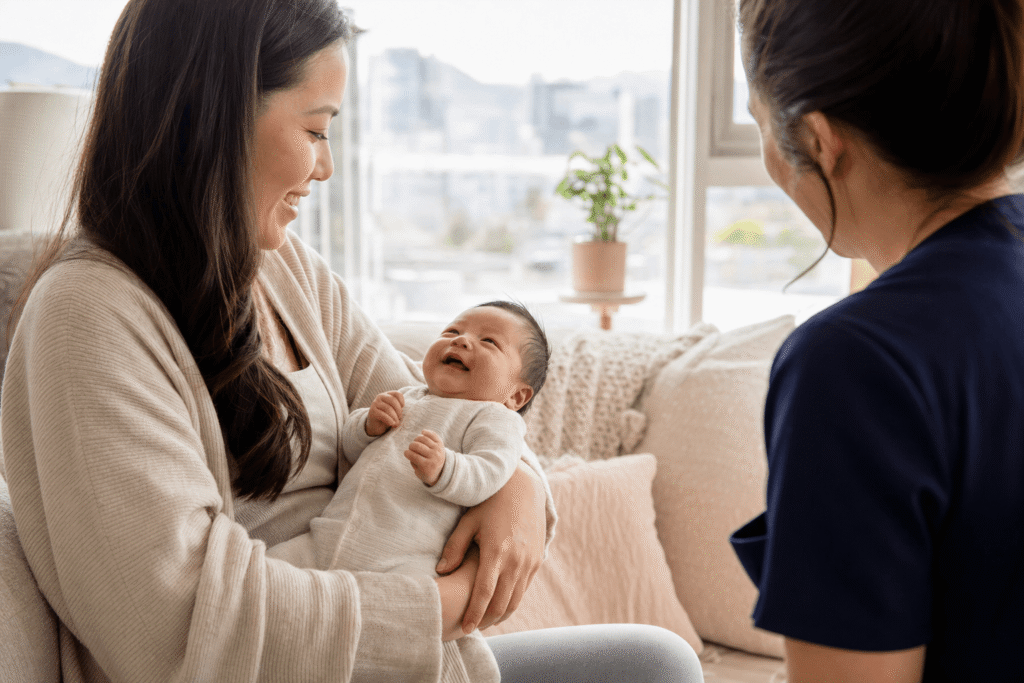
Seeing your newborn smile for the first time is one of the most magical moments of early parenthood. But when exactly do babies start smiling, and how can you tell if it is a real smile or just a reflex? Understanding your baby’s smile development helps you recognize important milestones and connect with your little one during those precious early weeks.
Key Takeaways
- Newborns display reflexive smiles from birth, but social smiles typically appear between 6-8 weeks of age
- Social smiles are responsive to faces, voices, and interactions, while reflexive smiles happen randomly
- Premature babies may reach smile milestones later based on their adjusted age
- You can encourage smiling through face-to-face interaction, gentle talking, and responsive caregiving
- Consult your pediatrician if your baby is not smiling by 3 months or shows other developmental concerns
When Do Babies Start Smiling? Understanding the Timeline
Most babies begin social smiling between 6 and 8 weeks of age, though the exact timing varies for each child. Some babies may smile as early as 4 weeks, while others take until 10 or 12 weeks. Both timelines fall within the normal range of development.
| Age Range | Smile Type | Characteristics |
|---|---|---|
| Birth to 6 weeks | Reflexive smiles | Random, often during sleep, no eye contact |
| 6-8 weeks | First social smiles | Brief, in response to faces and voices |
| 3-4 months | Consistent social smiles | Frequent, with eye contact, in response to interaction |
| 4-6 months | Smiles with laughter | Full facial expressions, accompanied by giggles and coos |
Several factors affect when your baby will first smile socially. Prematurity is a key consideration, as premature babies typically reach milestones based on their adjusted age rather than their birth date. Individual temperament also plays a role, with some babies naturally more expressive than others. The amount of face-to-face interaction your baby receives and their visual development also influence smile timing.
Reflex Smiles vs Social Smiles: How to Tell the Difference
Not all newborn smiles are created equal. Understanding the difference between reflexive and social smiles helps you know what to expect as your baby develops.
What Are Reflexive Smiles?
Reflexive smiles, also called spontaneous smiles, appear from birth and even in the womb during ultrasounds. These smiles are involuntary responses that do not connect to external stimuli. You might notice your newborn smiling during sleep, while passing gas, or for no apparent reason at all.
Reflexive smiles typically last only a few seconds and do not involve eye contact or response to your presence. They are a natural part of your baby’s neurological development but do not yet indicate emotional connection or recognition.
What Are Social Smiles?
Social smiles are intentional responses to interaction with caregivers. These meaningful smiles appear when your baby recognizes your face, hears your voice, or responds to playful engagement. Social smiles involve the whole face, including the eyes, and last longer than reflexive smiles.
When your baby offers a social smile, they are communicating with you and showing the beginning of emotional and social development. This milestone marks an important shift from reflexive behaviors to intentional interaction.
Expert Insight from Newborn Company
Our postpartum care specialists in West Vancouver often help parents distinguish between reflexive and social smiles. A true social smile involves eye contact, full facial engagement, and occurs in response to your interaction. If you are unsure whether your baby is socially smiling yet, try talking or singing to them during alert, calm periods and watch for responsive facial expressions.
The Neuroscience Behind Baby Smiles
Your baby’s smile represents far more than a cute expression. Social smiling indicates significant brain development and the formation of important neural pathways that will support emotional and social development throughout life.
When your baby begins to smile socially, their brain is making connections between visual input from seeing your face, auditory input from hearing your voice, emotional recognition of positive feelings, and motor control of facial muscles. This complex coordination shows that multiple brain regions are developing and communicating effectively.
The mirror neuron system in your baby’s brain plays a crucial role in smile development. These specialized neurons fire both when your baby sees you smile and when they smile themselves, helping them learn social behaviors through observation and imitation. This neurological mirroring forms the foundation for empathy and social understanding later in life.
The social feedback loop that develops around smiling also promotes continued brain growth. When you smile at your baby and they smile back, your positive response releases dopamine and other feel-good neurotransmitters in their brain. This reinforces the behavior and encourages more social engagement, creating a cycle that accelerates neural development in areas responsible for emotional regulation and social bonding.
How to Encourage Your Newborn to Smile
While you cannot force developmental milestones, you can create an environment that encourages your baby to smile and engage with you.
Position your face about 8-12 inches from your baby’s face, the optimal distance for newborn vision. Make eye contact, smile broadly, and talk in a gentle, animated voice. This close interaction helps your baby recognize facial expressions and learn to respond.
When your baby coos, makes eye contact, or seems alert and engaged, respond with smiles, gentle talking, and positive attention. This back-and-forth interaction teaches your baby that their actions get responses, encouraging further social engagement. Babies are most likely to smile during calm, alert periods when they are not hungry, tired, or overstimulated.
Babies respond strongly to voices, especially higher-pitched, sing-song tones. Talk, sing, and narrate your activities throughout the day. The sound of your voice combined with your facial expressions creates powerful opportunities for connection.
What If My Baby Isn’t Smiling Yet? When to Be Concerned
Most developmental variations are completely normal, but certain signs warrant a conversation with your pediatrician.
Red Flags to Watch For
Contact your healthcare provider if your baby has not shown any social smiles by 3 months of age, does not make eye contact or track faces by 2-3 months, or seems consistently unresponsive to voices and faces. Also consult your pediatrician if your baby shows regression in smiling or other social behaviors, or if you have concerns about your baby’s vision or hearing.
Understanding Adjusted Age for Premature Babies
If your baby was born prematurely, use their adjusted age when evaluating milestones. For example, a baby born 8 weeks early would be expected to smile socially around 14-16 weeks after birth (6-8 weeks adjusted age). Discuss your premature baby’s expected developmental timeline with your pediatrician.
Professional Perspective
As postpartum care providers in West Vancouver, we remind parents that milestone ranges exist for a reason. Every baby develops at their own pace. However, trusting your instincts is important. If something feels off about your baby’s development or responsiveness, scheduling a check-up provides peace of mind and ensures early intervention if needed.
What Comes After Smiling: The Next Developmental Milestones
After your baby masters social smiling, a cascade of communication and motor milestones follows in rapid succession during the first year.
Around 2-3 months, babies typically begin cooing, making vowel sounds like “ooh” and “ahh” in response to your voice. By 3-4 months, most babies discover laughter. These delightful giggles usually emerge during playful activities like peek-a-boo or gentle tickling.
Between 4-6 months, babbling begins as babies experiment with consonant sounds, producing syllables like “ba-ba” and “da-da.” Around 6-9 months, babies start showing stronger attachment behaviors and may show stranger anxiety, demonstrating they can distinguish between familiar and unfamiliar faces.
By 9-12 months, many babies speak their first recognizable words, understand simple commands, and use more sophisticated gestures like waving goodbye. These milestones build directly on the social foundation established by those first smiles.
Cultural Variations in Baby Smiles
While the biological timeline for smiling remains consistent across cultures, how parents interpret and respond to baby smiles varies significantly based on cultural traditions and parenting philosophies.
In Western cultures, particularly in North America and Europe, parents often emphasize face-to-face interaction and actively try to elicit smiles from their babies. A baby’s first smile is typically celebrated as a major milestone and photographed extensively. Parents in these cultures interpret early smiling as a sign of happiness, healthy development, and secure attachment. They respond with enthusiastic praise, smiling back, and increased interaction.
In contrast, some East Asian parenting traditions place less emphasis on direct face-to-face play and may interpret smiles differently. Japanese parenting practices, for example, focus more on physical closeness through babywearing and co-sleeping. While smiles are appreciated, they may be seen as one part of overall harmony rather than singled out for special celebration. Parents respond with calm acknowledgment rather than animated enthusiasm.
Some Indigenous cultures view baby development holistically, seeing smiles as signs of spiritual connection to family and community. In certain First Nations traditions, a baby’s first smile might be celebrated with small ceremonies or gift-giving, interpreting it as the baby’s spirit settling into their earthly family. The response involves community recognition rather than just parent-child interaction.
In some African and Middle Eastern cultures, protecting babies from excessive attention is traditional. Parents may interpret early smiles as blessings but respond with more reserved acknowledgment to avoid drawing unwanted attention or “evil eye.” This does not mean less love, but rather a different cultural framework for protecting infants.
Understanding these cultural variations helps parents recognize that while milestone timing is universal, the meaning and importance placed on specific behaviors reflect cultural values. What matters most is that babies receive responsive, loving care within whatever cultural framework feels authentic to your family.
Capturing Your Baby’s First Social Smile: Practical Photo and Video Tips
Your baby’s first real smile is a fleeting moment you will want to preserve. Here are practical tips for capturing this precious milestone on camera.
Keep your camera or phone easily accessible during typical smile times, usually during morning alert periods after feeding. Set your phone camera to burst mode, which takes multiple shots rapidly, increasing your chances of catching the perfect smile.
Natural light works best for baby photos. Position your baby near a window during daytime, avoiding direct sunlight on their face. This soft, diffused light creates flattering images without harsh shadows or the need for flash, which can startle babies.
Get down to your baby’s eye level rather than shooting from above. This perspective creates more engaging photos and better captures eye contact and facial expressions. Focus on your baby’s eyes to ensure the most important part of the image stays sharp.
For video, keep clips short and authentic. A 10-15 second video of genuine interaction captures more emotion than a long, staged recording. Talk to your baby naturally while recording, as your voice will help them smile and add precious audio memories to treasure.
Consider enlisting help from your partner or a family member. Have another person interact with your baby while you handle the camera, or use a tripod or phone stand to record video while you engage directly. The most authentic smiles happen during real connection, not when you are distracted by camera settings.
If you are filming, position the camera slightly above eye level and angle it down toward your baby. This angle is flattering and captures facial expressions clearly. Record in short bursts during natural interaction rather than trying to orchestrate the perfect moment.
Remember that the goal is to capture genuine moments, not to create stress. If your baby seems fussy or the photography session feels forced, put the camera down and simply enjoy the connection. There will be many more smiles to photograph in the weeks ahead.
Need Support During Your Newborn’s Early Weeks?
Newborn Company provides expert postpartum care in West Vancouver, helping families navigate developmental milestones with confidence. Our experienced care specialists offer in-home support, guidance, and reassurance during those precious early weeks. Contact us today to learn how we can support your family.
Frequently Asked Questions
When do babies start smiling socially for the first time?
Most babies start smiling socially between 6-8 weeks of age, though some begin as early as 4 weeks and others take until 10-12 weeks. These first social smiles are brief and occur in response to faces and voices.
What is the difference between a reflex smile and a social smile?
Reflex smiles happen randomly, often during sleep, without eye contact or response to interaction. Social smiles occur in response to faces and voices, involve the whole face including the eyes, and show intentional communication.
How can I encourage my baby to smile?
Position your face 8-12 inches from your baby, make eye contact, smile broadly, and talk in a gentle, animated voice. Respond to your baby’s coos and eye contact with positive attention during calm, alert periods when they are not hungry or tired.
Why do babies smile in their sleep?
Sleep smiles are reflexive responses, not related to dreaming or social interaction. They are involuntary muscle movements that occur as part of normal newborn neurological development and gradually decrease as social smiling increases.
What should I do if my baby isn’t smiling by 2 months?
Many babies do not smile until 10-12 weeks, which is normal. If your baby makes eye contact and seems responsive, give them more time. Consult your pediatrician if your baby shows no social smiles by 3 months or seems unresponsive to faces and voices.
Do premature babies smile later than full-term babies?
Yes, premature babies typically reach milestones based on their adjusted age rather than birth date. A baby born 6 weeks early would be expected to smile socially around 12-14 weeks after birth, which equals 6-8 weeks adjusted age.
Creating Joyful Connections With Your Newborn
Your baby’s first smile marks the beginning of a beautiful journey of communication and connection. While the timing varies from baby to baby, that magical moment when your little one looks into your eyes and smiles back at you makes all the sleepless nights worthwhile.
Remember that every baby develops at their own pace. Focus on creating warm, responsive interactions during your daily routines. Talk to your baby during diaper changes, make eye contact during feedings, and engage in gentle play during alert periods. These simple activities provide the foundation for healthy social and emotional development.
If you have concerns about your baby’s development or simply want expert support during these early weeks, professional postpartum care can provide guidance, reassurance, and practical help. At Newborn Company, we support West Vancouver families through every milestone, offering experienced care that helps both babies and parents thrive.
Trust your instincts, enjoy these precious moments, and know that your baby’s smile is coming soon. When it arrives, you will recognize it instantly, and it will be worth the wait.